Thursday, March 17, 2016

Lambing - Who New An IBC Container Could Be So Useful?


One of the wettest winters on record has resulted in Ellers being continually saturated and ironically the pond field has become the driest.

We had thought about moving the sheep to our neighbours land, but the sheep had a refusal to load moment or two! Meaning the pond field it was for our first lambing year!
 
There was no way we were going to be able to move the field shelter as at the moment is mud glued to the ground, so we came up with the plan of making pens with shelter area out of hurdles, tarpaulin sheets and the sides were made out of IBC containers (large plastic contains used to store water and other farming feeds and products).
Clover
Half term week was our due date for lambing and we started lambing right on time with Clover having twin ewe lambs on 11th February.  We only have five ewes and I am sick of saying the ewe with the forward facing horns and two spots on her side, so yes she is now called Clover and the other four ewes were named as they lambed too.
Two Horns

A couple of days later and two horns lambed with twin ewes again, then Jo, Bramble and finally Thistle on the 14th March. So now we have three sets of twins and two singles and fingers crossed things will continue to go ok with lambing 2016. I think I now have a little more understanding of farming and have learnt so much with our first lambing. Although there have been a few worries at times so far I am still hooked on sheep!
Jo Ewe


The benefits sometimes of getting up early!

Bramble
Thistle

It flooded for one day and we had snow another day!

Jo ewe on baby sitting duties!


Camera Traps are Great - Otters!

Every so often we find Otter spraint down Ellers, but a few weeks ago Andrew started finding spraints and Otter dinner remains in one place. This could maybe mean one thing, could we possibly have a holt under one of our Alder trees?!

We have put camera traps out before, but had no luck in the past. Normally we get pheasants, ducks and rats, but this time we had a real chance of getting the Otter. So Matthew deployed his camera trap and we caught this great footage!

Our next camera aim has to be the Kingfisher and Barn owl, so far I have only managed to get sketchy footage of the Barn owl on my phone camera.


Wednesday, December 9, 2015

Storm Desmond Hits – Is Mother Nature Trying To Tell Us Something?


River Bela Sat 5 December 2015
You don’t have to be Sherlock Holmes to realise if you have land next to a river at some point it is going to flood. When we got Ellers last year we were very much aware of this fact and one of the aims of having Ellers was to show how to manage land in a flood plain. Flooding has always been at the back of our minds, but what a crazy 24 hours Storm Desmond brought. With already saturated ground and Environment Agency (EA) flood warnings changing very quickly from Amber to Red we knew the River Bela was going to be high, but we were not quite prepared for how high.
 
As high as 15 November 2015 on 5 December 2015
Saturday morning (5th December 2015) the Bela was nearly the same level as when it flooded on the 15th November 2015 so the question was 1) when is it going to stop raining and 2) how high will the Bela get this time? Our new mobile field shelter is located at the same level as the meadow and pond field where the chickens and bee hives are located. Previously until Storm Desmond these locations were considered the safe zones from flood, but as the day went on it was clear that these areas of the field were in danger. By 2pm on Saturday we started checking Ellers more regularly and by 8.30pm water was lapping at the field shelter doors and it was looking like the our two hen houses could also be flooded. Our sheep and Smudge (Emma who works for us horse) were locked out of the field shelter and encouraged with hay to stay on the hillock (highest part of the field) and the hen houses were put on bricks. Everything that was in danger was moved to the hillock and then all we could do is keeping checking on animals through the night. I did the last check at 12.30am and Andrew and Ray checked about every hour and half until 5:30am.
 
Environment Agency Food Records (https://flood-warning-information.service.gov.uk/)

One good thing came out of the night checks as we did have a glimpse of the nocturnal life at Ellers with our local Barn owl taking shelter on our fence posts and being an opportunists as she hunted the edges of the flood water. The kingfisher also had new feeding grounds and did not seem bothered about us humans. 

Our worry was that the water was going to go over the Beetham road bridge and if that happened then things were going to get really serious. Between 3 and 4am the water peaked at 2.11 metres, which is the highest ever record level (previously the last highest recording was in 1999 and the water peaked at 1.73 metres). This resulted in over a foot of water through the mobile field shelter, water lapping under the Hen houses and importantly the water had reached the top of the arch of the road bridge. By 5am the water level seemed to be similar, but by 6.30am the water started to thankfully retreat slowly and it had stopped raining! Huge relief! Animals all safe on the hillock, hens saved by bricks and the flood came within 14cm of the bee hives!

Sunday 6 December - Animals getting some welcome hay!


By Mid morning Monday (7th December) the Bela was back to a more normal level and we escaped lightly with a couple of fence repairs and field shelter to muck out. However others were not so lucky and Bela flooded homes (many never flooded before), Beetham Paper Mill, roads and football pitches.
 
Monday 7 December 2015

Trees planted last year made it though the floods!


Nearly back to normal
 
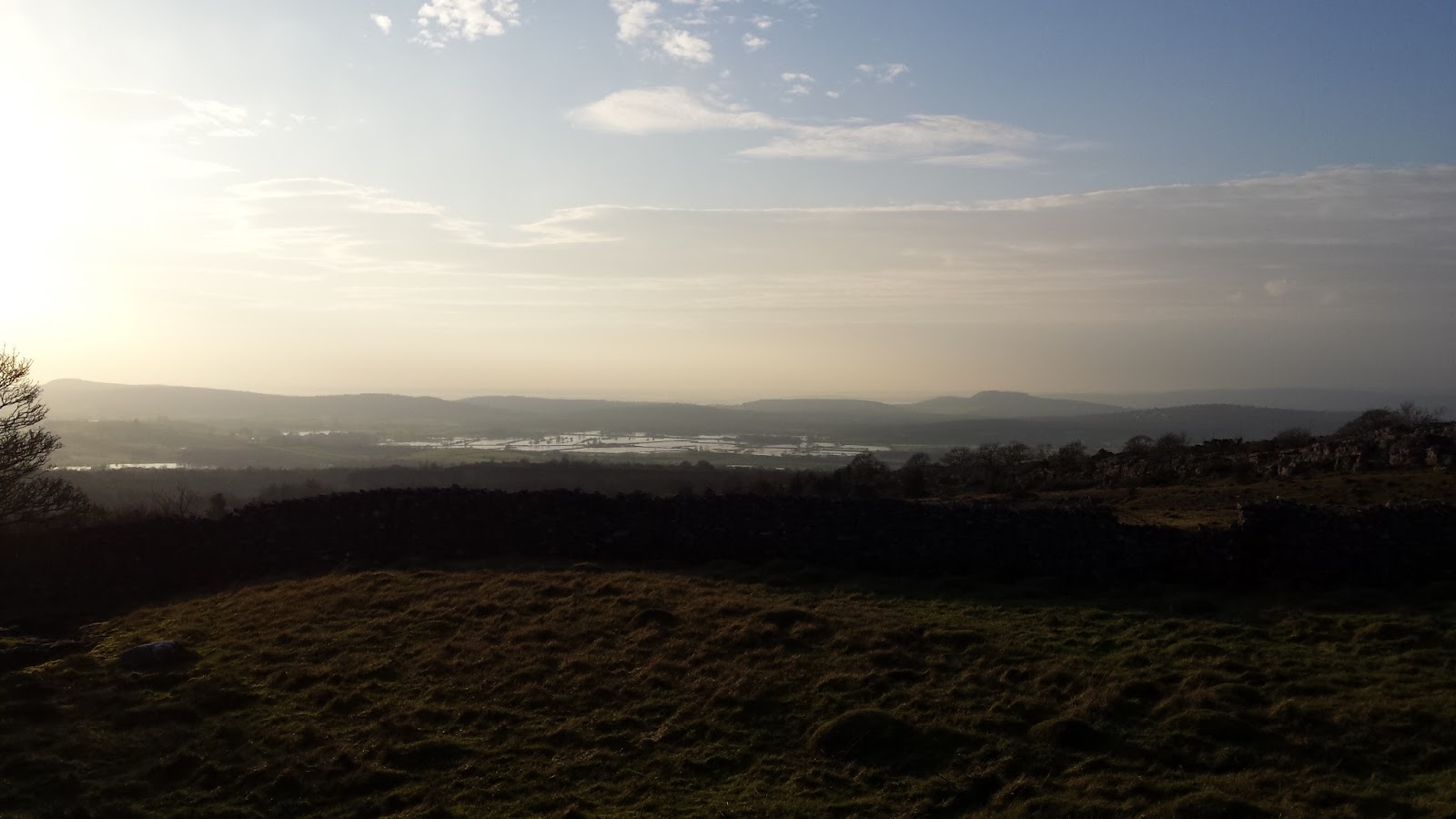
Hale Moss in flood, taken from Farleton Knott
Is this a once in 100 year flood event? I am not too sure, with climate change our weather is evolving and flooding is just one element that we are going to have to adapt too. I have now lived in Cumbria for 10 years and have witnessed many floods in the Lake District and between 2005 and 2011 every November I experienced  big floods. I always say that if it rains in the Lake District for more than six hours there is a risk of flooding! There is still standing water in many fields and I can already hear the echo’s of many land owners saying we need to dredge the rivers and ditches, but I really believe we are past this thinking and we need to apply some science and common sense to the situation as it really is inevitable that in some areas you are always going to get flooding. For example just down the road from Ellers we have an area called Hale Moss, which has been massively drained for farming. However, this area at one time was a glacial lake, then a moss and is now mainly farmland with moss habitat around the edges. When we have lots of rain the area just reverts back to its natural geology of a lake until the water subsides.
 
We all need to change how we manage our land and not on an individual basis but as a catchment. By looking at whole landscapes and zoning it for different land uses we could make a huge different to how we deal with big flood events like Storm Desmond. The journalist George Monbiot is quite rightly highlight these issues (http://www.theguardian.com/commentisfree/2015/dec/07/hide-evidence-storm-desmond-floods-paris-talks), although the question is will the government and large land owning charities who could make a difference listen and also speak out?


Monday, November 2, 2015

Autumn Means Jumping Fish


We called in to the Heron Corn Mill this week and I found myself being in awe at seeing the migrating Atlantic salmon and Sea trout jumping up the fish pass to get to the spawning grounds at Ellers Meadow and beyond on the River Bela .
 
Heron Corn Mill Fish Pass
For hundreds of years fish were unable to reach spawning ground further up the River Bela, but then in 1990 a fish pass was put in by the Environment Agency. By looking down on the fish pass from the viewing area it seems a very simple construction, however it is made up of a series of 12 steps with pools to allow the fish to have a rest areas before they take the next leap. This engineering feat made a significant conservation gain overnight and the Bela is now recognised locally as being a very important river for spawning Atlantic Salmon and Sea Trout.  
 
Although migrating fish can now move up the stream to their spawning ground there are still parts of the River Bela that need better habitat management to maintain and increase fish populations. The river fencing work we did last November at Ellers Meadow with a more extensive livestock system means another part of the jigsaw is now getting the right management. Like the fish pass the answer to better river management is simple, fence the riverbanks to cut agricultural pollutions levels and get the right land management adjacent to our rivers. Although the river has only been fenced a year, the river banks at Ellers are already look more stable and agricultural pollution and riverbed disturbance has ceased. Although the fish pass happen 25 years ago, it is only now that the habitat management at  Ellers has changed for the better! 
Note: If you would like help managing your river contact your local Rivers Trust. We worked closely with South Cumbria Rivers Trust and Milnthorpe Anglers Associations to fence off our river.


Ellers Meadow River Bank Summer 2014

Ellers Meadow River Bank November 2015

Tuesday, September 15, 2015

Our Tup is cleverer than he looks!


Last November we bought five pedigree Jacob sheep and earlier this year we managed to buy a nice tup from ProCo a small animal care college near Wigan. Being with the College he has already been named by the students and he is called Rambo! Having a very small herd the dilemma is always should we keep Rambo with his ladies? After consulting farming family and friends we came up with the plan that Rambo should stay with the ewes until it was time to take him out and then we would put him back in with the ewes at tupping time. This is normally around November to get Easter lambs (sheep gestation period is 152 day or around 5.4 months).  

After some happy weeks with the ewes we decided in July it was time to move Rambo to the end paddock. This was not an easy task in its self, but Andrew and Ray managed to split them up. Rambo then seems to go into depression, to start with he did a lot of pacing and then he seemed to sleep a lot. A week a so a go we had a very stormy night and the next day on animal checks I had to do a double take, Rambo was not in his field, the fences were not down and then I realised he was back with the ewes! I came to the conclusion that human intervention must be at play here and the gate must have been opened for him. However later that day we managed to get the sheep in again and split them up, but to our astonishment we then watched Rambo jump the fence! So back to the drawing board, we either get deer fencing or is there something else we could try. Deer fencing is not an option so we bought Rambo a ‘ram apron’ (I will let you google this!) but all I can say is it lasted 48 hours, before Rambo somehow broke the straps.
So now we have concluded that we are going to let nature take is course and have a happy tup instead and expect early lambs. We are not a fell farm we just have five ewes after all!


Rambo getting his raddle maker put on, so hopefully we can predict when the lambs will arrive! 


Sunday, July 19, 2015

Putting the Meadow back into Ellers

As I write this the firsts ever National Meadows Day has passed on the 4th July and as I read the media coverage about the day I thought it was about time I write my blog about our new meadow. The plan had always been to have a traditional meadow back at Ellers, but over Easter when we dug out the wildlife pond we were left with a lot of bare ground and this gave us the push to start the process of recreating a meadow.

Cornflowers are out! July 2015


As meadow is in our fields name we think there must have always been a meadow at Ellers, but it must of been a few decades since a meadow has been seen here. We have an old stone drain running the whole length of the land that channels a spring through Ellers and putting my curators hat on I am convinced that at some point we had a traditional water meadow. The stone culvert is lined with 1 metre long by 50cm wide cut limestone and at the time of its construction it must have taken some man power to get all the stones in place. There is also some redundant metal work left over adjacent to the river that indicated that there must have been some sort of sluice gate in place.  The aim of a water meadow was not to flood the land, but to keep a trickle of water running through the meadow to keep the grass roots warm and protected them from frost. This resulted in good spring growth and an early meadow crop (http://www.farm-direct.co.uk/farming/history/watermeadow/). 

Since the Second World War agriculture has changed dramatically through the need to produce more food. Many hay meadows were ploughed for crops and others have changed to now produce silage, which in turn for examples enable farmers to produce higher milk yields and means there is enough fodder to overwinter livestock indoors. According to a recent report from the charity Plantlife over 97% of wildflower meadows have been lost since the 1930s, which equates to 7.5 million acres (3 million hectares).  In addition, species-rich grassland now only covers a mere 1% of the UK’s land area (http://www.bbc.com/earth/story/20150702-why-meadows-are-worth-saving).

So considering the history of Ellers and the fact that we strongly believe that meadows play a key role in the UK ecosystems it was one of our main aims to get a meadow back at Ellers. First thing we did  back in the winter was to get some soil samples completed to see if the PH levels were suitable for meadow species and ideally you need a soil PH of between 5 and 6.5 (http://bumblebeeconservation.org/images/uploads/Bumblebee_seed_mix_for_neutral_soils.pdf ) . We were please to find out that our soil averaged out at PH of around 6.5 and also the levels of Phosphorus (P) Potassium (K), Magnesium (Mg) were on the low level.


Fern trying to help chain harrow! April 2015
Once the pond works had been completed we chain harrowed the ground to break up the soil sods and made a good bed for our meadow seed. Our dog Fern thought this was particularly  good fun as she got to run with the land rover!  

After chain harrowing  we could start seeding  and we used a hand seed spreader, which made light work seeding an area just over 1 acre. We have gone for a mix of traditional meadow grass seed and a wild flower mix from Boston Seed and Germinal Seeds. We have also used a damp ground seed mix for the pond edge. The ideal time to sow seeds is either in the spring or the autumn and we just got there in time!

It took a few weeks before we started to see the seeds germinating, but the meadow is now starting to take shape! Not sure if we are going to get many flowers this year, but I think next year we will really see a difference and we will be able to say we have a 1 acres species rich meadow back in our Parish! 

Seeds Germinating - May 2015


Really starting to grow - June 2015

Meadow taking Shape July 2015


Sunday, May 31, 2015

Grand Designs For Sand Martins and Kingfishers - A Step by Step Guide


I must admit I have a bit of a passion for the wildlife of rivers and Sand martins and Kingfishers are two of key species of our UK waterbodies. Most people know what a Kingfisher is but I have learnt recently that Sand martins  are it seems a little bit unknown and I have found many people  looking puzzled when I have explained we have built them an artificial nesting site.
 
Sand Martins (Riparia riparia) are the smallest member of the European hirundines or martin and swallow family and if you wondering why they have ‘sand’ in their name it because they nest is sandy banks on riverbanks, coastal cliffs, gravels pits and in recent years artificial breeding sites that us humans have made for them. Being a summer migrant Sand martins are an international bird spending the winter in Africa and the summer in Europe.
 
This presents two issues for this species, firstly they need a good winter in Africa and unfortunately due to drought they have been some noticeable population crashes in the past. The second issue Sand martins have had to deal with is the habitat loss of their breeding sites. Gradually over the years many rivers, streams and becks have had their banks altered and made more like Roman roads (or canalised). In theory this makes water travel faster from A to B along stone or concrete walled channels and not as it once was a meandering waterway with sandy banks. Other issues for Sand martins have been listed as livestock eroding riverbanks and the law that is there to protect nesting birds means that many developers and gravel pit extraction companies will now not leave unused areas suitable for Sand martin as they fear prosecution for disturbing  any nesting Sand martins which take up use (Sand Martin Artificial Breeding Sites by Edward Cowley 2009).  Sand martins are now listed as Amber Species of European Concern.
 
Thankfully ornithologists and conservationist have stepped in and now on may disused gravel pits that have become nature reserves and other areas where we know there is a gap in nesting habitat they have made artificial breeding sites. We know the River Bela once had Sand martins nesting and therefore when we were planning the pond it just seem like an interesting idea to add an artificial bank for Sand martins and Kingfishers. The River Bela is a tributary of Morecambe Bay and the nearest Sand martin nesting site that we know of is 3.5 miles away on a nearby river which is also flows into Morecambe Bay. Knowing this in theory Ellers should be an ideal place for such a grand design! It is too early to say but the Kingfisher has already been seen checked out the pond and on the 29th April 2015 Sand martins were seen feeding along the River Bela! Sand martins have continued to feed along the river and have been checking out the new pond, but as yet we have not seen any signs of nesting. We may not get them nesting this year, but at least we know they have clocked their new nesting site for next year!

Sand Martin and Kingfisher Artificial Breeding site – Our step by step Guide!
 

What we came to call the bible! 
1.       Firstly you need to get hold of what we have called the bible - Sand Martin Artificial Breeding Sites by Edward Cowley 2009 from www.sandmartintrust.org.uk . There also have some links to youtube films, which are really useful. All material were sourced from our local building merchants.

 
2.       We have gone for a mix of artificial nests in pipes for Sand martins and a natural earth bank so both Sand martins and Kingfishers can build there own nests.


The Plan (Only in Andrew's head at time of building)!
 
 
 3. Foundation. Made of concrete with reinforcing bar.


 4. Walls made of concrete block 5m by 2m.


 5. Once the walls are up, cement rendering started.


6. With the front board tempoaryly on a template could be draw around the block holes. Then we we could cut out the randon located nesting entrances.


7. Nesting pipes 70cm long and 127mm in diameter. Pipes backed with plastic bags and attached with cable ties. Once pipes are in place they can be half filled with sand and then the front board bolted in place.


8. Once the artificial nesting site was complete, we filled up the natural nesting bank with a layers of 50/50 sand/soil at a ratio of 50:1 dry cement. A temporary front board was put up to  support the back filling of these layers of sand, soil and cement. We then left the front board on for about a week to allow the dry cement to go off, which has left a really hard bank that we hope is similar in structure to a riverbank.


9. Once all the bank was in place, we set to and painted the rendered walls and front board  to give it a more natural look and I finished it off with a Sand martin silhouette painting.